Deeptech – The Future of Innovation is Now
So, What Does Deeptech Actually Mean?
Deeptech innovations and startups are developing global changes for the future.
Deeptech innovations are defined as “disruptive solutions built around unique, protected or hard-to-reproduce technological or scientific advances” (De la Tour et al., 2017). This definition has been used in reference to technologies like artificial intelligence, robotics, and quantum computing, among others a part of the 4th Industrial Revolution (Dionisio et al., 2023).
Deep-tech startups are highly rooted in their scientific and technical foundations, with complex technologies providing the ability to create significant global impacts. Canada has been a hub for many deeptech technologies creating these global changes.
Like D-Wave Quantum in Burnaby, BC who were the first to sell a commercial quantum computer (CBC/Radio Canada, 2015), University of Toronto’s Professor Emeritus Geoffrey Hinton, the “Godfather of AI“ and winner of the Nobel Prize in Physics in 2024 for his foundational discoveries that enable machine learning (Kalvapalle, 2024), or Ionomr Innovations, co-founded by SFU alumnus and faculty, who have developed revolutionary ion exchange membrane technology, and were named to the 2025 Global Cleantech 100 list for the fourth consecutive year (Fuel Cell Works, 2025).
But, with this potential influence, comes significant risks associated with the development and growth due to deeptech technologies’ sophisticated nature.
Deeptech’s “Valley of Death”
The notion of the valley of death stems from the deeptech venture journey - which many startups don’t escape - given “failure rates well above 90%” due to their risk profile (Romme et al., 2023).
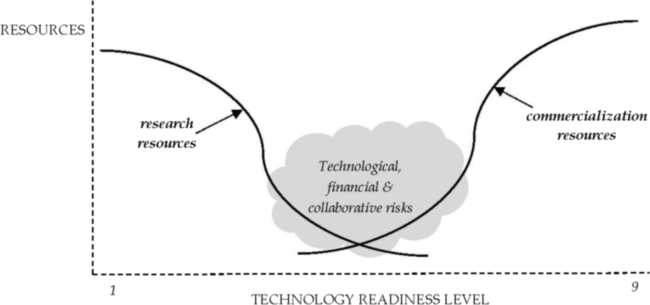
Figure 1. Valley of Death in Deeptech Venturing. Source: Romme et al., 2022, p.3
The figure above shows this ‘impending doom’ for deeptech ventures, where funding runs out between the research and commercialization phases of technological readiness due to their prolonged development stage in regards to the technologies’ complexity.
Three Key Risks for Deeptech Startups
Throughout deeptech venture journeys, there are three major risks that impact growth: technological, financial, and collaborative (Romme et al., 2023).
The technological risks are associated with the high likelihood of failure of the technology. For deeptech ventures, there may be difficulties scaling up in an industrial setting considering their complex nature.
The financial risks come with their long route to market, leading to higher financial requirements.
The collaborative risks arise from the requirement of the correct partners and innovation ecosystem. Stakeholders and partners must see the value in these ventures to maintain the long and costly journeys to market.
How to Succeed in this Hostile Landscape
With many risks associated with deeptech ventures, where can they find means to succeed?
Kask & Linton (2023), professors at Örebro University School of Business in Sweden, have laid out five principles for overcoming obstacles in deeptech startup journeys.
- Assembling a network of complementary partners in the specific industry or sector. It is critical for deeptech startups to have a wide network of complementary knowledge to go beyond the technical core of the venture.
- Mobilizing necessary human capital and expertise. Building the correct team is extremely important for deeptech startups. Hiring people with the right expertise will help drive innovation through development to market.
- Cultivating an entrepreneurial mindset. Deeptech startups require entrepreneurial minded innovation systems, which prioritize potential over risk, challenge the status quo, and accept the possibility of uncertainty.
- Supporting funds through long and expensive development and testing stages. This means focusing on the technology with the highest potential rather than ‘safeness’ of the investment.
- Reducing information asymmetry in the financing journey. Capital can be difficult to obtain with many high risks associated with the investment. Deeptech startups must ensure venture capitalists have access to the right information and knowledge to properly assess the value of the technology.
Where VentureLabs Can Help
VentureLabs recently launched its new program Perago that addresses the unique needs and challenges faced by deeptech and life sciences ventures.
Perago helps deeptech companies transition from startup to investor-ready, driving business growth alongside technology development to attract customers, partners, and investors.
We know your journey as a deeptech venture is different from a traditional startup. Perago's approach is designed to help you move from Seed to Series A, and ultimately help you to solve the world’s toughest challenges.
Are you a Deeptech company?
Apply to Perago today!
References
CBC/Radio Canada. (2015, December 14). Take a peek inside NASA’s Quantum Computing Lab | CBC news. CBCnews. https://www.cbc.ca/news/science/d-wave-quantum-nasa-1.3364886
De la Tour A, Soussan P, Harlé N, Chevalier R, Duportet X (2017) From tech to deep tech: Fostering collaboration between corporates and startups. Report by BCG and Hello Tomorrow. http:// media-publications.bcg.com/from-tech-to-deep-tech.pdf
Eduardo Avancci Dionisio, Edmundo Inacio Junior, Cristiano Morini, & Ruy de Quadros Carvalho. (2023). Identifying necessary conditions to deep-tech entrepreneurship. RAUSP Management Journal, 58(2), 162–185. https://doi.org/10.1108/rausp-09-2022-0203
Fuel Cells Work. (2025, January 15). IONOMR innovations named to the global cleantech 100 for fourth year - fuelcellsworks. Fuel Cells Works. https://fuelcellsworks.com/2025/01/15/green-technology/ionomr-innovations-named-to-the-global-cleantech-100-for-the-fourth-year-in-a-row
Kalvapalle, R. (2024, October 8). Geoffrey Hinton wins Nobel prize in physics. University of Toronto. https://www.utoronto.ca/news/geoffrey-hinton-wins-nobel-prize
Kask, J., & Linton, G. (2023). Editorial: Five principles for overcoming obstacles in deep-tech startup journeys. Journal of Small Business and Enterprise Development, 30(1), 1–3. https://doi.org/10.1108/JSBED-02-2023-47
Romme, A. G. L., Bell, J., & Frericks, G. (2023). Designing a deep-tech venture builder to address grand challenges and overcome the valley of death. Journal of Organization Design (Aarhus), 12(4), 217–237. https://doi.org/10.1007/s41469-023-00144-y
Prepared by:
Brigita Cecic
Marketing Associate
SFU VentureLabs
brigita@venturelabs.ca
venturelabs.ca
Related Posts